
The Cream of Wheat Chef: A Face Without a Name
For 127 years, a face sold Cream of Wheat. The man behind it earned fifty cents for the sitting and was never named. This is what the record shows.

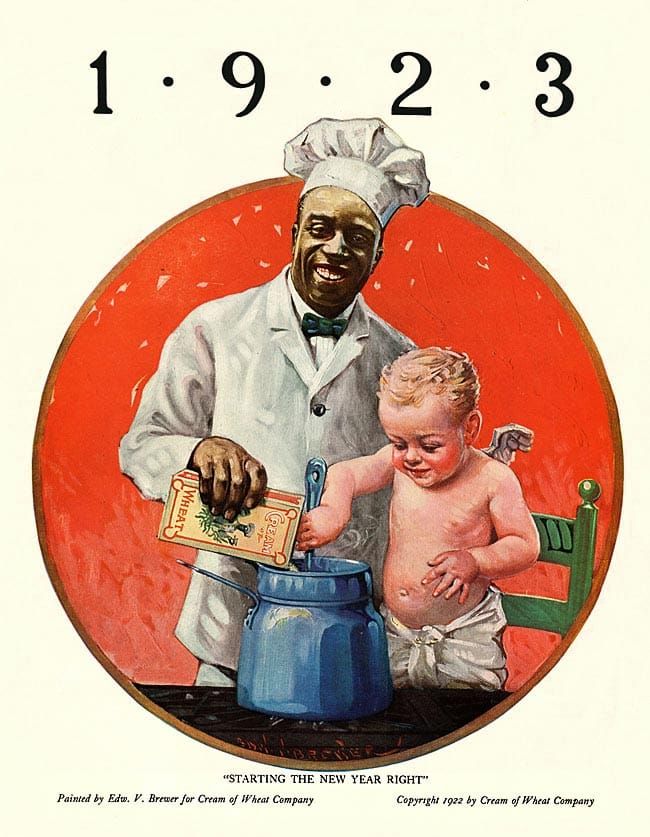
How a photograph taken for fifty cents became one of American advertising's most enduring and contested images.
In the early 1900s, the Cream of Wheat Company commissioned a new reference photo for its chef mascot. The assignment fell to John Lee Mahin, an advertising agent working on behalf of company executive Emery Mapes. Mahin offered an almost offhand account of what followed: he was seated at a Kohlsaat restaurant on South Dearborn Street in Chicago when he noticed a waiter with what he described as an "unusually winning smile." He offered the man fifty cents to walk to the nearby Copland's Studio and sit for a portrait. A dozen photographs were taken. Mahin selected the best one and had the man’s missing tooth retouched. He submitted the image to the company but didn’t record the man’s name.
The chef character had existed since the company's founding year of 1893, when Mapes, one of the original North Dakota millers who developed the product, designed the early packaging himself. Working with limited capital and considerable marketing instinct, Mapes settled on the image of a Black chef, which he named "Rastus." The name drew from a well-established convention in popular entertainment: the minstrel-stage character of the same name, a stock figure defined by cheerful subservience and comic incompetence. The stage Rastus was a visual type as much as a name: darkened skin, exaggerated features, bright clothing, a costume designed to read as buffoonish from the back row. The choice placed Cream of Wheat squarely within the visual vocabulary of its era. Alongside Aunt Jemima, which had also launched that same year, Black figures served a specific commercial function: to signal domesticity, warmth, and a particular social order that white consumers of the period found reassuring. The product sold.
Mapes relocated the company from Grand Forks to Minneapolis in 1897, securing better rail shipping rates and a more reliable wheat supply. He eventually built a residence on Lake of the Isles, one of the city's most prestigious addresses.
Sometime around 1900, the company transitioned from the original illustrated caricature toward a more photographic representation, the image that Mahin's South Dearborn encounter produced. The resulting portrait was, by most measures, a dignified one: a professional chef in a white uniform and toque, composed and direct. What the company then did with that image went in two directions. In some advertisements, the chef appeared in exactly those terms, as a skilled professional in a hotel kitchen. In others, the campaign layered the "Rastus" character back over the photograph, placing minstrel dialect in the chef's mouth and visual stereotypes in the surrounding imagery, undermining the professional dignity of the original portrait with the conventions it was apparently never quite allowed to escape. In a 1921 advertisement, the chef holds a hand-lettered sign written in broken dialect, misspelled words, dropped letters, as though the man in the white uniform could not write his own language.
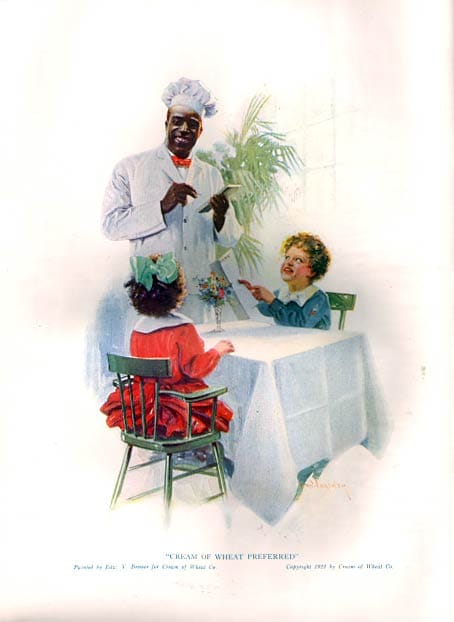
The identity of the man in the photograph remained undocumented until a researcher named Lasorda began examining the question in the early 2000s. The strongest candidate to emerge was Frank L. White, born in Barbados around 1867, who immigrated to the United States in 1875 and was naturalized as an American citizen in 1890. White worked as a chef across a range of settings including Chicago restaurants, railroad dining cars, passenger steamships, and was employed in Chicago around the time Mahin made his visit to Copland's Studio.
White never made a formal claim, but he told neighbors in Leslie, Michigan, where he settled in the early 1920s, that he had posed for the Cream of Wheat advertisements. His obituary in the Leslie Local-Republican, published upon his death on February 15, 1938, identified him as a "famous chef" who had "posed for an advertisement of a well-known breakfast food." Lasorda conducted genealogical research that confirmed the broad outlines of White's biography: his Barbadian birth, his immigration, his naturalization, and concluded that White was the most plausible match for the Mahin photograph, while acknowledging that definitive proof remained out of reach.
White's estate at the time of his death was valued at $400.
In June 2020, B&G Foods, which had acquired the Cream of Wheat brand, announced a review of the packaging following consumer complaints that the chef image perpetuated racial stereotypes. On September 24, 2020, the company announced that the image would be removed from all packaging. Their statement acknowledged that "research indicates the image may be based upon an actual Chicago chef named Frank White," while noting that the depiction nonetheless reminded consumers of earlier, explicitly offensive iterations of the character.
The chef image had appeared on Cream of Wheat packaging for 127 years. That corporate press release was the only time Frank White’s name was mentioned.